Shop Window, Open Front or Deep Recess?
Shop window, open front or deep recess: see how each shopfront frames goods, marks the entrance and shapes a passerby’s sense of the street.
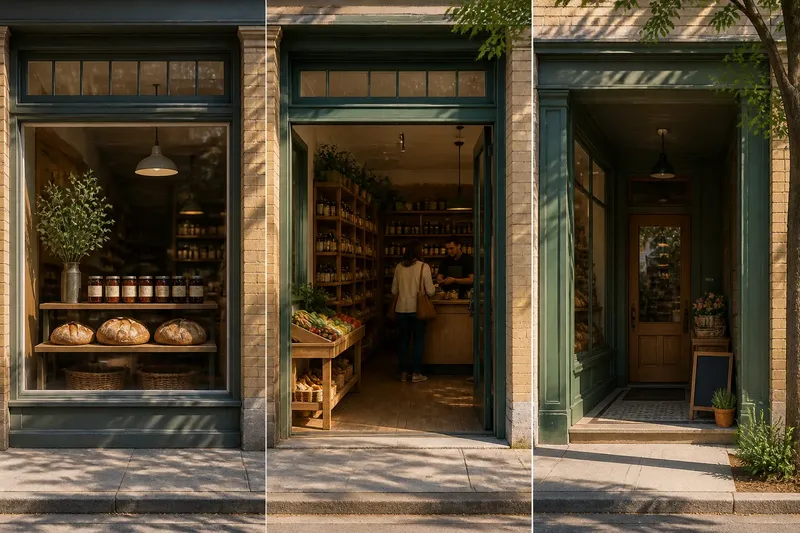
Which shopfront makes a small business feel inviting without turning the sidewalk into a display case? A shop window, open front or deep recess answers that question differently. Each sets a boundary between merchandise and street, and each gives an approaching customer a different clue about where to look and how to enter.
Say a fictional neighborhood grocer is taking over a narrow unit on a busy block. The owner sells bread, jars of preserves and seasonal produce, and wants passersby to understand the shop before they reach the door. The unit has a broad street opening, a shallow interior, and an existing setback that could be retained as a recess. The owner and designer consider three storefront arrangements. Their choice turns not on fashion, but on what the street needs to see and how the entrance should behave.
The Corner Decision
The three options begin with different relationships between the glass line and the public sidewalk. A shop window holds the goods behind a prominent pane. An open front reduces the visual boundary, letting the interior appear continuous with the street. A deep recess moves the doorway back from the building face, creating a sheltered threshold and a pocket of space between the sidewalk and the shop.
These forms are not simply three styles of glazing. They assign different jobs to the storefront. A window presents objects at a distance; an open front invites a glance into the room; a recess makes the entrance itself more legible. The same shop could combine elements, but one should lead. If every part tries to announce the business in its own way, the frontage becomes a committee meeting with glass.
For the grocer, the first useful question is not “Which looks most welcoming?” It is “What should a person understand while still moving?” A passerby may notice a loaf, recognize a doorway, or read the depth of the room. Those are distinct visual events, and the storefront can make one easier than the others.
What The Window Frames
A shop window gives merchandise a clear visual border. Glass separates the display from weather, hands and the everyday movement of the sidewalk. That boundary can help small, carefully arranged goods read as a deliberate composition rather than as stock spilling toward the pavement.
For the grocer, a window might frame a few loaves on a timber shelf, with jars grouped behind them and a glimpse of the counter farther inside. The pane can also carry lettering, a menu card or operating information, but each addition competes for the same field of view. A window crowded with labels may protect the goods while making it harder to see what the business actually sells.
The window’s strength is controlled distance. It allows someone to inspect goods without entering, which can suit a bakery, florist, bookshop or specialist retailer whose products benefit from close visual attention. Its weakness is that the glass can make the shop feel like an exhibit. Reflections from traffic, neighboring façades or a bright sky may sit across the display, while interior lighting can make the room seem separate from the street.
Placement matters as much as the objects. A low display can catch attention from a seated person or a child, while a high display may be easier to see across a crowded sidewalk. Neither arrangement is automatically better; the goods, street activity and neighboring openings shape what can be read. A shopkeeper can check the view from several approach angles rather than judging the display from inside.
Use the window when the goods need a frame. Keep one view of the interior open so the glass does not become a wall with excellent inventory.
What An Open Front Reveals
An open front makes the transition between sidewalk and interior visually softer. A broad glazed opening, a door held open during business hours, or a recessed entry with little visual obstruction can let the room’s activity carry outward. The customer sees more than products: a counter, staff movement, seating or the depth of the shop may all become part of the invitation.
That visibility can be useful for a business whose appeal depends on the experience inside. A café may want a passerby to see people at tables; a repair shop may want its workbench to signal what happens there. For the grocer, visible shelves and the counter could suggest that the shop is active and easy to enter, even before someone reads a sign.
But openness is not the same as clarity. If the threshold has no visible cue, someone may wonder whether the opening is an entrance, a service bay or a display area. A counter positioned too near the door can make the route feel blocked. A dense run of shelves at the front can erase the view inward, leaving an open façade that communicates little more than its own lack of a pane.
The grocer could keep the front clear, set a small produce table just inside, and place the counter deeper in the room. That arrangement would show activity while preserving a readable path from sidewalk to shop. It would also avoid using loose goods to claim space on the public way, where local rules and access needs may apply.
Open fronts work best when the interior has a clear first impression. They ask the shop to do its explaining in public, so the first few feet should support the message rather than interrupt it.
What A Recess Marks
A deep recess shifts the door behind the main façade. That setback produces a short approach zone: the customer leaves the flow of the sidewalk, passes between the outer face and the entrance, then enters the business. Even without a large sign, this change in depth can make the doorway easier to identify.
For the grocer, the existing setback could hold the door and a modest sign, with the shop window on one side and a view into the interior on the other. The recess would give someone a place to pause while deciding whether to enter, without standing directly in the doorway. It could also lend the shopfront a sense of thickness that a flush plane of glass lacks.
A recess can, however, hide as much as it frames. From an oblique approach, the entrance may disappear behind a return wall. A dark or cluttered pocket can look closed even during business hours. If the display sits at the outer edge while the door retreats into shadow, customers may notice the goods but miss the actual entry.
Depth also has a practical cost in attention. The owner must decide what the recess is for: a clear approach, a display, a brief pause, or some combination that does not obstruct access. A stack of delivery crates or a chalkboard placed at the narrowest point can turn the intended threshold into an obstacle. Keep the entrance visible from both directions of approach, and treat the recess as part of the storefront rather than spare storage.
A recess is useful when the doorway needs a distinct address. It works less well when the setback becomes a small, unlit room that happens to be outside.
Reading The Three Forms?
Which form makes goods easiest to see?
A shop window gives goods the most explicit frame and can protect a composed display from direct contact. An open front shows merchandise in its working setting, while a recess can place goods beside a sheltered entrance. Choose according to whether the product benefits more from presentation, context or proximity.
Which form makes the entrance clearest?
A recess can make a doorway legible by setting it apart from the building face, provided the opening remains visible and the approach stays clear. An open front can also read clearly when the door, counter and route inward are easy to distinguish. A window alone may need a separate visual cue so customers do not mistake the display for the entrance.
Can a shop combine all three?
Yes, a storefront can use a display pane beside an open doorway set into a recess. The combination works when the parts have distinct roles: the window presents goods, the opening reveals the business, and the setback marks entry. If all three compete for signs, objects and attention, the arrangement loses its hierarchy.
What should be judged from the sidewalk?
Check what a moving passerby can identify: the kind of business, the location of the door and the first visible feature inside. Look from both directions and at an angle, not only from directly across the street. A drawing can make a doorway look obvious; a passing delivery truck may have other opinions.
The Grocer’s Choice
Imagine the owner favors an open front because it seems most welcoming. During a walk-through of the fictional space, the counter turns out to be directly behind the entrance, and a tall produce display blocks the view of the room. The owner shifts the counter deeper inside and lowers the front display, but the opening still gives little shelter to someone pausing at the door. The final choice is a shallow shop window beside a deeper entry recess, with a clear view through the doorway to the counter.
The observable result the owner expects is specific: a passerby can recognize the bread and preserves through the window, locate the entrance from either direction, and see that the shop continues beyond the threshold. The recess is not treated as a second display shelf. It stays open enough to read as an approach, while the window carries the more detailed arrangement of goods.
This is not a universal recipe. A café with visible seating might choose a more open frontage; a jeweler might give the window the dominant role; a narrow shop with a deeply set door might use the recess as its strongest street-facing feature. The useful comparison is how each form handles three tasks: framing goods, marking the entrance and connecting the room to the passing street.
For the grocer, the decision can be checked by walking past the frontage at ordinary pace. If the goods, doorway and interior become visible in that order without one hiding the next, the arrangement is doing its job. Shop window, open front or deep recess is less a style question than a choice about what a passerby can read before deciding to stop.
Before committing to a built change, review applicable access, glazing and storefront requirements with the relevant local authority or a qualified design professional. For the visual decision, start with a simpler test: stand where people approach, then ask what the frontage tells them first.