The Plaque Is Not the Artwork
Public art is easier to read when you separate the artwork, its setting and its plaque, then decide which part answers your question about the place.
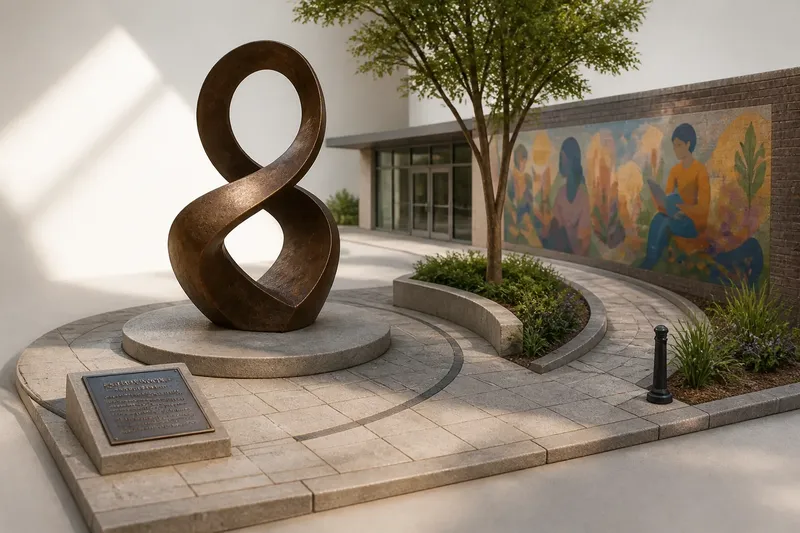
Public art can leave you wondering where the work ends: at the bronze figure, the paving around it, or the plaque beside it. To understand public art in a city setting, sort those parts by what each one does. The artwork makes the artistic proposition; the setting shapes how it is encountered; explanatory text supplies information. They may be designed together, but they are not interchangeable.
That distinction matters when you are looking at a memorial, a mural, a sculpture outside a library, or an installation built into a plaza. A plaque can name a maker or explain a dedication. It cannot, by itself, turn an ordinary object into an artwork. Nor does a work stop being art simply because there is no plaque in sight.
Start with your question
The useful decision is not whether a plaque is important. It is which part of the place you are trying to understand. A visitor seeking the work’s form should begin with the object or arrangement. Someone trying to understand why it stands there should look at the site and its use. A reader seeking names, dates, or a stated intention should turn to the text, while remembering that text is one account, not the whole experience.
These questions can overlap. The point is to avoid treating the nearest label as the answer to everything. A plaque tends to make claims in a compact, official voice. The work may be more ambiguous, and the setting may contain evidence the plaque does not address.
When the object leads
If your question is “What am I looking at?”, start with the artwork’s visible choices. Notice its material, shape, scale in relation to a person, and the way its parts are arranged. For a mural, consider the wall as a surface and the image’s relation to windows, doors, or a corner. For a freestanding sculpture, notice whether it faces a path, interrupts a line of sight, or invites people to pass around it.
Do not mistake subject matter for the entire work. A sculpture of a person is not only a representation of that person; its posture, finish, placement, and relation to viewers also shape what it does. A painted wall may depict a local scene, but the image’s edges, colors, and location can matter as much as its depicted objects.
Imagine you are standing beside an abstract steel form outside a community center. Its plaque names the artist, but your immediate question is how the work occupies the entrance. Follow the walking route, notice whether the form blocks or frames the doorway, and observe how its surfaces change as you move. That is a direct reading of the artwork in space; the plaque can add identity and context afterward.
When the object itself is your concern, give it a moment before reading the label.
When the setting leads
If your question is “Why here?”, the setting deserves attention. Public art is encountered amid routes, buildings, landscaping, traffic, and ordinary routines. A work beside a courthouse entrance may feel different from a similar object on a waterfront path, even if the object has not changed. The location affects who sees it, how closely they can approach, and what else competes for attention.
Look for practical relationships rather than assuming that every nearby feature was designed as part of the artwork. A paved circle may be a gathering space, an access route, or simply the surface around a sculpture. A wall mural may occupy a blank wall chosen for visibility, or it may respond to the architecture. The setting can inform interpretation without automatically becoming part of the artwork.
Ask what the work’s placement makes possible. Can a person approach from more than one direction? Does a building’s doorway create a natural pause? Is a tree canopy, retaining wall, or change in pavement relevant to viewing the work, or merely nearby? These are questions of encounter, not proof of an artist’s intention.
Site plans, project descriptions, or a public-art program’s records may clarify whether the artist deliberately incorporated paving, lighting, or landscape. In their absence, describe what you can observe and leave intention open. “The work sits beside the path” is firmer than “the artist designed the path to guide visitors.”
When the plaque leads
If your question is “Who made it, and what is it called?”, the plaque may be the quickest source. It can identify an artist, title, commissioning body, dedication, or materials. Read the words closely, and separate straightforward credits from interpretive statements. A name and title are information; a sentence about what the work represents is a particular framing.
Public art labels often have limited space. They may explain the occasion for a commission or the person being commemorated, but omit the work’s formal choices, contested history, or changing use of the site. Their brevity is not necessarily evasive. A small plate is a poor container for every context a visitor might want.
If the plaque is missing, weathered, or absent, the work does not become an anonymous object without meaning. You can describe its visible qualities and setting, then seek another source, such as the city’s public-art inventory or the institution responsible for the site. Do not infer authorship from style alone; materials and visual motifs can be shared by many artists.
If a plaque’s wording seems to settle an interpretation too neatly, treat it as evidence of how the work has been presented, not an order to stop looking.
When the parts blur?
Is the base part of the artwork?
It can be, but proximity alone does not decide the matter. A pedestal may be a conventional support, a designed component, or both; look for visual continuity and consult project information if the distinction matters.
Does a memorial plaque count as public art?
A plaque can carry artistic design, but its subject and purpose do not make it art automatically. Consider its lettering, material, composition, and relation to the site, while distinguishing those qualities from its role as a marker or dedication.
Can the setting become part of the work?
Yes, when the artwork is conceived to include or respond to elements of the site. A plaza, a building surface, or a route may be integral, but nearby paving and landscaping do not become art by association alone.
What if the plaque and the work disagree?
First check whether the plaque identifies the same work and whether its wording describes a dedication, a subject, or an interpretation. If the difference remains, keep both accounts visible rather than silently treating the label as the final authority.
Choose by situation
Use the part that answers your actual question. The following distinctions help when a site offers several plausible starting points:
- You want to describe what is physically present: begin with the artwork’s form, material, and arrangement. This keeps description separate from assumptions about meaning.
- You want to understand why the work occupies this location: examine paths, entrances, sightlines, and nearby uses. The setting answers questions of encounter better than a title alone.
- You need the artist’s name or the work’s title: read the plaque, then confirm against an official inventory if the plate is unclear or incomplete. This is a factual identification question.
- You want to know what a dedication commemorates: start with the plaque or the commissioning institution’s description. Then distinguish the commemorative purpose from the artwork’s visible features.
- You are unsure whether a surrounding feature belongs to the work: describe the feature separately and look for a project record that explains the intended boundary. This avoids absorbing every nearby object into the artwork.
- You are reading the work with someone else: compare what each person notices before checking the text. Different observations can coexist without requiring one official sentence to settle them.
Say you encounter a tiled panel beside a transit entrance, with a short plaque and a patterned floor nearby. If you want to know who made the panel, begin with the plaque. If you want to describe its visual effect, look at the tile pattern and the panel’s relation to the entrance. If you want to know whether the floor pattern was designed as part of the work, check the project record rather than assuming the two surfaces share an author. Each question calls for a different source.
Keep the boundary clear
When you talk or write about public art, name the part you mean. “The sculpture’s polished surface catches the light” describes the artwork. “The work stands beside a bus shelter” describes its setting. “The plaque identifies the dedication” describes the text. Clear nouns prevent a common muddle: attributing the plaque’s explanation to the artwork as though the words were the work’s own voice.
That does not mean the three parts should be kept in separate mental boxes. A work can answer its setting, and a plaque can change what a visitor notices. The distinction is useful precisely because the parts interact. It lets you say what you see, what you know, and what remains uncertain without pretending that one small plate can speak for the whole site.
For public art, begin with the question in front of you: form, location, identity, or commemoration. The plaque is often useful for the last two. The artwork and its setting answer the first two, sometimes together. Once you know which source is doing which job, a missing label becomes a gap in information, not a verdict on the work.